
Last Updated: November 26, 2026
Quick Summary
The boat transport companies in Australia worth shortlisting fall into three groups: direct carriers who own the trailers and prime movers, specialist yacht shipping lines, and quote-comparison marketplaces that pass your job to subcontractors. At Load Up, we run weekly routes connecting Darwin, Perth, Adelaide, Brisbane and Melbourne. That distinction matters more than any star rating, because the company you book is not always the company that turns up.
- Ask for quotes broken down into component charges rather than one number, because a single figure hides avoidable costs.
- A quote given without your trailer-inclusive length, beam and height is a guess that usually gets revised upward.
- Before handover, photograph the hull, prop, trailer and existing damage from four angles and request a condition report.
- Ask the carrier in writing what insurance covers in transit, the excess, exclusions and how a claim is lodged.
- Pad every contact point where straps, chains or bunks meet the hull to prevent gelcoat abrasion.
Table of Contents
- Which boat transport companies in Australia are worth shortlisting?
- What drives boat transport quotes
- Preparing a boat for transport: the owner’s checklist
- Protecting a boat from transport damage
- Frequently Asked Questions
Which boat transport companies in Australia are worth shortlisting?
The shortlist of boat transport companies in Australia falls into three groups: direct carriers who own the trailers and prime movers, specialist yacht shipping lines, and quote-comparison marketplaces that pass your job to subcontractors. At Load Up, we run weekly routes connecting Darwin, Perth, Adelaide, Brisbane and Melbourne. That distinction matters more than any star rating, because the company you book is not always the company that turns up.
Below, we break down what each type does well, what it costs you in control, and how to prepare a vessel for the trip.
What drives boat transport quotes
A boat transport quote is a stack of charges, not a single rate. Knowing which parts are fixed and which move tells you whether two quotes are genuinely comparable.
- Line-haul distance, road kilometres between collection and delivery, priced per kilometre or as a lane rate.
- Vessel dimensions, length overall including trailer, beam, and height on the trailer. Length is the number most owners underestimate, because a boat on a trailer is longer than the hull, and height determines whether the load fits under structures or needs a route survey.
- Permits and escorts, oversize loads above certain width, height, or length thresholds need permits from the relevant state or territory road authority, and the largest combinations need pilot or escort vehicles. Each jurisdiction sets its own thresholds, so a cross-border move can require several permits.
- Access at both ends, low branches, a steep ramp, a soft verge, or a marina with restricted truck access all add handling time, priced as a site assessment or waiting charge.
- Dismantling and re-rigging, removing a hardtop, radar arch, clears, or outriggers to reduce height is billable labour, and so is refitting.
- Loading and unloading method, a boat that can be towed onto a trailer is cheaper than one that needs a crane, a slipway, or a specialist hydraulic trailer.
Ask for the quote broken down into its component charges rather than as one number, because a single figure hides which costs are avoidable.
Watch out: a quote given over the phone without your trailer-inclusive length, beam, and height is a guess, and it usually gets revised upward after inspection. The same applies to any quote that does not state whether permits and escorts are included or billed at cost.
Ask any provider what happens if the load is measured differently at pickup, and what the waiting charge is if the vessel is not ready when the truck arrives. Get both in writing before you compare prices.
A quote is a stack of charges, and these are the components that move the final figure.
| Quote component | What it covers | Note |
|---|---|---|
| Line-haul distance | Road kilometres between collection and delivery | Priced per kilometre or as a lane rate |
| Vessel dimensions | Length overall including trailer, beam, height on trailer | Length is the number most owners underestimate |
| Permits and escorts | Oversize loads above state or territory thresholds | Each jurisdiction sets its own thresholds |
| Access at both ends | Low branches, steep ramp, soft verge, restricted marina access | Priced as a site assessment or waiting charge |
| Dismantling and re-rigging | Removing hardtop, radar arch, clears or outriggers | Billable labour, and so is refitting |
| Loading and unloading method | Towed onto trailer versus crane, slipway or hydraulic trailer | A towable boat is cheaper than one needing a crane |
Preparing a boat for transport: the owner’s checklist
Preparation starts with the paperwork and ends with a photograph of every surface.
- Empty fuel to a low level and disconnect the battery
- Remove electronics, fishing gear and loose items
- Secure hatches, lockers and the windscreen
- Photograph hull, prop and trailer from four angles
- Confirm trailer-inclusive length, beam and height in writing
- Check registration and any interstate permit requirements
For a longer interstate run, our walkthrough of how to transport a boat from Perth to Brisbane sets out the sequence step by step. If you are moving a van at the same time, the caravan preparation checklist covers the same groundwork.
Protecting a boat from transport damage
Damage in transit usually comes from four places: contact points where straps and bunks meet the hull, gear that shifts inside the boat, tie-downs that loosen over distance, and stone strike from the tow vehicle. Each has a cheap fix compared with a repair.
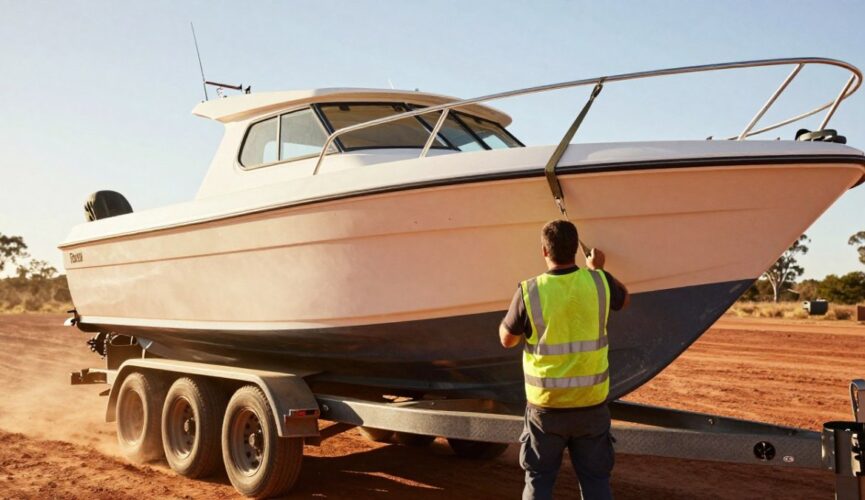
Contact points. Pad every place a strap, chain, or bunk touches the hull. Foam blocks, carpet offcuts, or strap sleeves spread the load and stop gelcoat abrasion. Check that trailer bunks and rollers are adjusted to the hull before loading, because a bunk that only touches at one corner concentrates force.
Secured gear. Anything that can move will move. Remove electronics, fishing gear, and loose items, or stow and strap them down. Hatches, lockers, and windscreens should be latched and, where the manufacturer allows, taped or braced. A bimini or clears left up will flap and tear at highway speed.
Tie-downs. Straps stretch and settle over the first few hundred kilometres. Ask how often a provider re-checks tension at scheduled stops on a long run.
Road debris. On long highway legs, stone strike is a real risk to gelcoat and props. Ask whether a provider fits stone guards or positions the vessel to reduce exposure as part of its standard setup.
The condition report. This step decides whether a damage claim succeeds or fails. Before handover, photograph the hull, prop, trailer, and any existing damage from four angles, and ask for a condition report noting pre-existing marks. Repeat at delivery before you move the boat.
Insurance and liability. Ask the carrier, in writing, what insurance covers the vessel in transit, the excess, exclusions, and how a claim is lodged. If the value is high, confirm whether you need your own cover. Keep the condition report, photos, and correspondence together so a claim can be lodged without delay.
Our step-by-step guide to preventing boat transport damage covers gear securing, padding, and tie-down checks in more detail. Before you book, ask any carrier how they handle oversized loads and route planning, and get the answer in writing alongside their insurance details. When you are ready to compare options, you can arrange interstate boat transport directly with us.
The gap between a smooth delivery and a damaged hull usually comes down to preparation and who is actually holding the keys. Load Up runs weekly services to Darwin, Perth, Adelaide, Brisbane and Melbourne, handles boats, caravans and farm machinery, and covers both local and heavy interstate work. Get in touch with Load Up to make a booking or arrange a quote.
Frequently Asked Questions
How do I choose a boat transport company?
Check what equipment the carrier runs for your vessel size, whether it holds the right permits for oversized loads, and what insurance covers the trip. Ask for a fixed written quote that lists loading, transport and unloading, plus references for similar boats. Confirm transit times and how you will be contacted before delivery.
How much does it cost to transport a boat?
There is no flat rate. Boat transport quotes depend on distance, boat length and beam, weight, trailer or cradle requirements, permit needs for oversized loads, and how flexible your dates are. Remote or regional pickups add cost because return legs are harder to fill. Ask for a written quote and ask what is excluded, such as crane hire or marina fees, so the final invoice matches the quote.
Do I need to prepare my boat before transport?
Yes, and it protects both the boat and your claim if something goes wrong. Remove loose gear, electronics and personal items, drain fuel to a sensible level, secure hatches and covers, and note existing damage with photos. Preparing a boat for transport also means checking the trailer or cradle is rated for the vessel and that the vessel dimensions you supplied are accurate, since these determine permits and loading method.

