
Last Updated: November 4, 2026
Quick Summary
Protecting your boat from boat transport damage starts with a thorough pre-departure inspection of the hull and trailer, and it takes most owners under an hour. Remove all loose gear, pad every strap contact point, and use four ratchet straps at the stern and forward positions. Document existing marks with dated photos before handoff.
- Walk around the hull and trailer with a torch and notepad, photographing anything already worn.
- Loose gear is the most common cause of boat transport damage and the easiest problem to fix.
- Use four ratchet straps: two at the stern angled 30 to 45 degrees from vertical, two forward.
- Pad every strap contact point with closed-cell foam, carpet offcuts or purpose-made pads.
- Ask the carrier to sign or acknowledge the condition report before loading.
Table of Contents
- Preparing Your Boat for Interstate Transport: The Pre-Departure Inspection
- Removing Loose Gear and Securing Fixtures to Prevent Boat Transport Damage
- Protecting the Hull and Contact Points During Towing
- Choosing and Positioning Tie-Down Straps for Safe Boat Transport
- Securing the Mast, Boom, and Outboard Motor for the Road
- Boat Shrink Wrap Cost and Cover Options for Weather Protection
- Marine Transport Insurance Requirements and Documenting Pre-Existing Condition
- Book Your Boat Transport With Load Up
- Frequently Asked Questions
Preparing Your Boat for Interstate Transport: The Pre-Departure Inspection
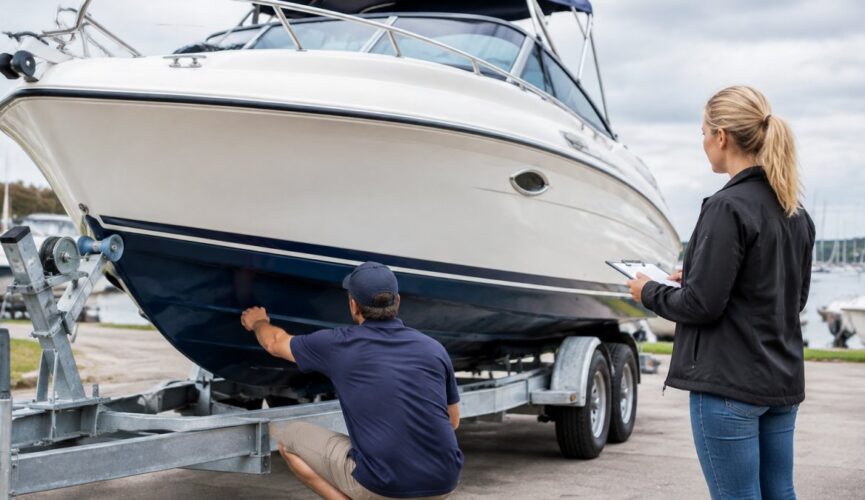
Protecting your boat from transport damage starts before the trailer moves. A thorough pre-departure inspection is the single best defence against boat transport damage, and it takes most owners under an hour. Load Up runs weekly service between Darwin, Perth, Adelaide, Brisbane and Melbourne, and boats that are checked properly before departure are easier to move cleanly.
Walk around the hull and trailer with a torch and a notepad. Look for cracks, chips, soft spots and loose fittings. Photograph anything that already looks worn, because you will need those photos later if a claim comes up.
Check the trailer too. Tyres, lights, winch strap, rollers and bunks all need to be sound before the boat goes anywhere near a highway. A failed roller at speed can cause serious damage.
What to Check Before You Leave
Run through this checklist in order, and tick each item off as you go:
- Hull for cracks, chips and stress marks
- Trailer tyres, bearings, lights and brakes
- Winch strap and safety chain condition
- Rollers and bunks for wear or movement
- All hatches, lockers and drains closed
- Registration and insurance paperwork in the vehicle
- Photos of every existing mark, dated
Watch out: a winch strap that looks fine on the driveway can fray inside the drum. Pull it out fully and inspect the whole length, not just the visible section.
Removing Loose Gear and Securing Fixtures to Prevent Boat Transport Damage
Anything that can move will move. Loose gear is the most common cause of boat transport damage, and it is also the easiest problem to fix. Strip the boat down before it leaves your driveway.
Take off fishing rods, anchors, ropes, coolers, life jackets, radios, sounders and safety equipment. Either leave them at home or box them and stow them in the towing vehicle. These items shift under braking and vibration, and a swinging anchor can punch through a hull.
Then work through the fixed items:
- Latch every hatch, locker and storage compartment
- Tape down or remove antennas and lights that stick up
- Secure bimini covers, clears and canvas so they cannot flap
- Remove or lock down anything mounted on a rail
What to Take Off, What to Tie Down
A simple rule: if it comes off without tools, take it off. If it needs tools, check it is tight and pad anything that could rub. Screens, cushions and covers should come inside the vehicle, not stay on the boat.
Protecting the Hull and Contact Points During Towing
Hull protection is where most damage is prevented or caused. The hull rests on bunks or rollers, and every one of those contact points is a place where gelcoat wears through. Pad them before you load.
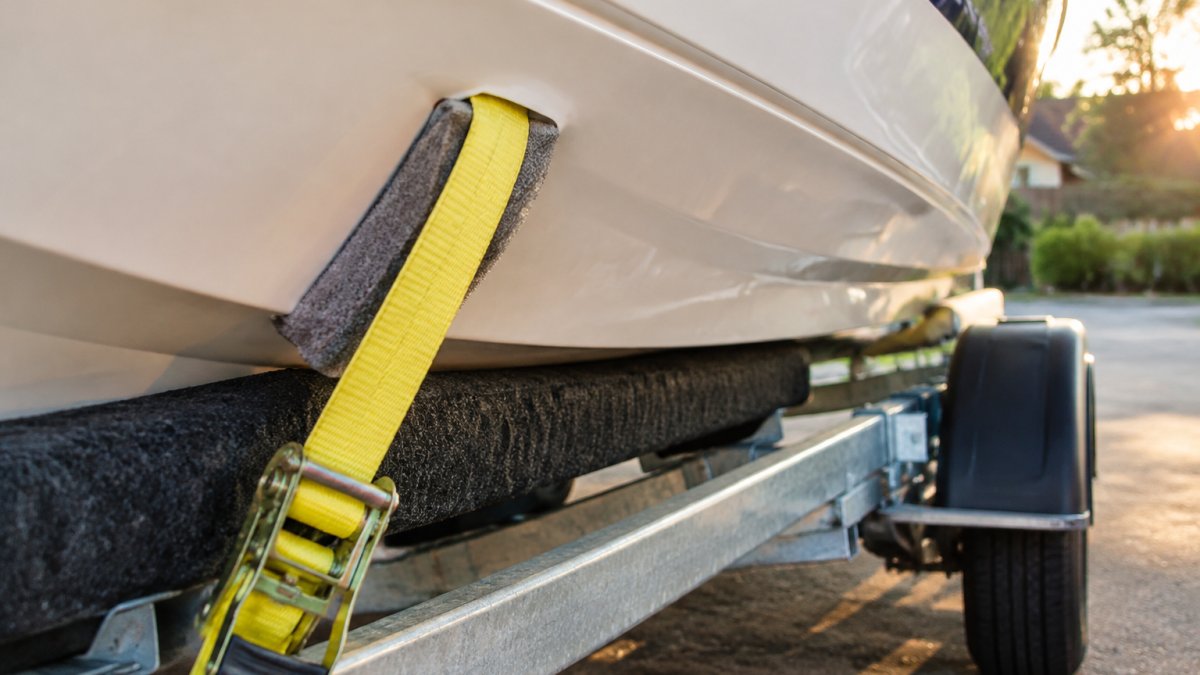
Use closed-cell foam, carpet offcuts or purpose-made pads at every strap contact point. Avoid running a bare strap over gelcoat, as vibration can wear it.
Check the support position as well. The hull should sit evenly on its bunks, with the weight spread across them. If one bunk carries more load than the others, that spot becomes a stress point.
Choosing and Positioning Tie-Down Straps for Safe Boat Transport
Tie-down straps hold the boat to the trailer, and where you place them matters more than how many you use. A good setup uses four ratchet straps: two at the stern and two forward, angled slightly outward to stop sideways movement.
Strap tension should be firm, not crushing, with no slack and no distortion of the hull.
Use the transom eyes, bow eye and trailer frame as strap contact points rather than cleats, rails or windscreen frames, and pad any point where a strap crosses a hull edge.
- Two stern straps angled out and back, about 30 to 45 degrees from vertical
- One or two forward straps pulling down and forward into the winch post
- Ratchet straps only, with the ratchet handle locked and the tail tied off
- Pads at every point where the strap touches gelcoat or a sharp trailer edge
Watch out: a strap that looks tight on the driveway can loosen as the boat settles on its bunks, so recheck tension during the trip.
Get in touch to make a booking or arrange a quote. →
A good tie-down setup follows a few simple rules on count, angle and contact points.
| Item | Value | Note |
|---|---|---|
| Ratchet straps | Four | Two at the stern, two forward |
| Stern strap angle | 30 to 45 degrees from vertical | Angled out and back |
| Forward straps | One or two | Pull down and forward into winch post |
| Strap type | Ratchet straps only | Ratchet handle locked, tail tied off |
| Contact points | Transom eyes, bow eye, trailer frame | Not cleats, rails or windscreen frames |
| Padding | At every gelcoat or sharp edge contact | Prevents wear from vibration |
| Tension | Firm, not crushing | No slack, no hull distortion |
Securing the Mast, Boom, and Outboard Motor for the Road
Projecting parts take the worst of the wind and the road debris. A mast, boom or outboard motor that moves even slightly will work itself loose over a long run. Secure each one to a solid point, and pad where it meets the boat.
For a sailing boat, lower and lash the mast to its crutch, and tie the boom down so it cannot swing. For a powerboat, tilt the outboard up, lock it, and brace it so it cannot drop or turn. Remove antennas and anything else that stands tall.
Boat Shrink Wrap Cost and Cover Options for Weather Protection
Cover choice comes down to three options: shrink wrap, a fitted travel cover, or no cover at all. Shrink wrap cost depends on the specifics of your boat and job, so ask for a quote. Shrink wrap can protect against weather, but it can trap moisture if the boat is wet when wrapped.
A fitted travel cover can be reusable and allows some airflow. The catch is that a loose cover flaps at highway speed and scuffs the gelcoat underneath. No cover is fine for a short run in dry weather, but it leaves the boat open to water intrusion, road debris and saltwater corrosion.
Whichever you choose, make sure hatches and drains are clear so water can escape rather than pool.
Marine Transport Insurance Requirements and Documenting Pre-Existing Condition
Insurance cover varies by insurer, so confirm your cover in writing before the boat leaves. Most policies require you to declare the move, the route and the carrier, and some exclude damage caused by poor preparation. Ask specifically whether the policy covers the boat while it is on a trailer or a carrier’s deck, and whether it pays for damage caused by straps, covers or road debris.
Documentation is your protection, and a structured record beats a few phone photos. Build a condition report on the day of pickup:
- Photograph the hull from bow, stern, port and starboard, plus close-ups of every existing mark, chip and scratch
- Photograph the motor, trailer, rollers, bunks and winch, and any fittings that could be blamed for damage later
- Date-stamp the photos and keep the originals, not just compressed copies sent by message
- Note the time and place of handoff, the carrier’s name and the load reference
- Ask the carrier to sign or acknowledge the condition report before loading
A common pattern is for damage claims to stall because the owner cannot show whether a mark was pre-existing. A dated photo set and a signed handoff record close that gap. Keep the report with your insurance paperwork and send a copy to the carrier before the boat moves.
Ask your carrier about tracking and delivery timing before you book. Inspect the boat before you sign off delivery, and photograph any new damage on the spot. You can read more about how interstate heavy haulage loads are tracked before you book.
Watch out: a carrier’s standard terms may require you to note damage at the point of delivery, so inspect before you sign and record anything you find in writing.
Book Your Boat Transport With Load Up
Preparation protects the boat, but the carrier protects it too. Load Up runs weekly service to Darwin, Perth, Adelaide, Brisbane and Melbourne, moving boats, caravans and farm machinery. Preparing your boat with the checklist above is still worthwhile.
When you are ready, book interstate boat transport or contact us with your route and boat details for a quote.
Frequently Asked Questions
What is the best way to protect a boat hull during transport?
Use padded contact points where straps and trailer bunks meet the hull. Ratchet straps should run at shallow angles to spread load, and never over sharp edges. Inspect the hull before departure and photograph any existing scratches or cracks. Check strap tension during long trips. If you are shipping rather than towing, ask the carrier how they pad and secure the hull, and
Should I use shrink wrap for boat transport?
Shrink wrap protects against weather, road debris and water intrusion, but it traps moisture if the boat is wet when wrapped. Boat shrink wrap cost varies with boat size and whether you do it yourself or hire a professional, so get a quote for your length. For short trips in dry weather, a fitted cover may be enough.
How do I secure loose items on a boat before shipping?
Remove everything that is not fixed: fishing gear, anchors, ropes, coolers, life jackets, radios, sounders and safety equipment. Store what you need in sealed containers and tie them down inside lockers. Latch all hatches and storage compartments. Secure the outboard motor, mast and boom separately. Loose gear causes most transport damage because it shifts and hits the hull or fittings during braking and cornering.
Do I need to remove electronics before transporting my boat?
Remove or secure electronics such as radios, sounders, GPS units and antennas. Vibration and road debris can damage exposed screens and mounts. If you leave them on, pad them and check they are firmly latched. Document any pre-existing damage with photos before departure, and confirm with your carrier what is covered under marine transport insurance requirements. Ask whether the policy covers electronics separately.

