
Last Updated: November 15, 2026
Quick Summary
Interstate boat transport insurance requirements mean the carrier is responsible for the boat while in their custody, limited by their contract and policy limits, while you must insure the gap to the boat’s real value. Keep your own comprehensive boat transport insurance active and confirm road transit cover with your insurer before pickup.
- Ask the carrier for a certificate of currency, not a verbal assurance, and check the insured party matches the business you contract with.
- A public liability certificate alone does not cover your boat; you need goods-in-transit or marine cargo cover.
- Policy limits are usually stated per load, so two boats on one float share the limit.
- Photograph the damage before the driver leaves and note it specifically on the delivery docket.
- Lodge with the carrier first, then your own insurer if liability is disputed or the limit falls short.
Table of Contents
- Who Is Legally Responsible for a Boat in Transit
- Boat Insurance During Road Transport: What Your Own Policy Actually Covers
- Marine Transit Insurance for Boats: When You Need It
- Carrier Liability Versus Your Own Comprehensive Cover
- Boat Transport Insurance Exclusions That Catch Owners Out
- How to Verify a Carrier’s Insurance Documents
- Boat Transport Insurance Claim Checklist After Damage
- Premiums, Excesses and How Insurers Value Your Boat
- Book Your Interstate Boat Move With Load Up
- Frequently Asked Questions
Who Is Legally Responsible for a Boat in Transit
Interstate boat transport insurance requirements start with a simple principle: the carrier is responsible for the boat while it is in their custody, but the extent of that responsibility is defined by the contract and their policy limits, not by goodwill. Load Up runs weekly services between Darwin, Perth, Adelaide, Brisbane and Melbourne, and the question owners ask most often is who pays if something goes wrong between pickup and delivery.
In general terms, the carrier is responsible for the vessel while it is in their custody, to the extent set by their contract and policy limits, and the owner is responsible for insuring the gap between that cover and the boat’s real value.
What the Carrier Must Hold
A professional boat transporter should hold a current public liability policy and a goods-in-transit or marine cargo policy that specifically names boat carriage. Ask for the certificate of currency, not a verbal assurance. The certificate shows the insurer, policy number, expiry date and the insured party, which must match the business you are contracting with.
Heavy vehicle operators also work under the National Heavy Vehicle Regulator’s mass and dimension rules, which govern how a boat and trailer are secured and moved across state lines. A carrier who cannot explain their obligations under those rules is a carrier who has not thought carefully about risk.
What the Owner Should Hold
Your own comprehensive boat policy should stay active through the move. Marine policies vary, and cover during road transit typically depends on the policy wording, including how the boat is secured and whether the carrier is declared. Ring your insurer before pickup and confirm that road transit is covered, whether the carrier’s details need to be noted on the policy, and what excess applies to a transit claim.
Boat Insurance During Road Transport: What Your Own Policy Actually Covers
Boat insurance during road transport is a specific extension, not an automatic feature. Many owners assume their marina or mooring policy follows the hull onto a truck. Whether it does depends on the policy, which may set its own conditions for transit.
Read the transit clause before you sign the transport agreement. If the clause requires the carrier to hold a minimum cargo limit, and the carrier’s limit is lower, your own policy may reduce or refuse the claim. That is the trap most owners walk into.
Marine Transit Insurance for Boats: When You Need It
Marine transit insurance is a cargo policy that can cover a vessel for a single journey or a defined period. Owners often consider it when the carrier’s liability limit is below the boat’s insured value.
A common mistake is buying transit cover after the boat is already loaded. Arrange it before pickup, with the vessel length overall, beam, weight and trailer details on the schedule.
Carrier Liability Versus Your Own Comprehensive Cover
Carrier liability and comprehensive cover do different jobs, and confusing them is the single most expensive error in this process. Carrier liability protects you only up to the policy limit and only for damage the carrier is legally liable for. Comprehensive cover protects the hull regardless of fault, subject to your excess.
| Cover type | Who holds it | What it pays for | Key limit |
|---|---|---|---|
| Carrier liability | Transport provider | Damage the carrier is legally liable for | Policy limit per load |
| Marine cargo/transit | Either party | Loss or damage in transit | Insured value of boat |
| Comprehensive boat | Owner | Hull damage regardless of fault | Sum insured less excess |
Where the two overlap, insurers apportion the claim. Where the carrier’s limit is exhausted, your own policy picks up the balance, which is why declaring the carrier to your insurer matters.
Boat Transport Insurance Exclusions That Catch Owners Out
Boat transport insurance exclusions are where claims die. Typical exclusions include inadequate securing of the load, undeclared modifications, damage from pre-existing defects, and loss caused by the owner’s failure to prepare the vessel. Pollution clean-up, salvage and wreck removal are frequently excluded from standard cargo policies and need separate cover.
Preparation Failures That Void a Claim
The most common voiding mistake is leaving gear loose in the hull. Loose items become projectiles on a rough road and insurers treat the resulting damage as owner-caused. Remove electronics, secure hatches, drain fuel to the carrier’s limit and photograph everything before loading. Our guide to interstate boat transport safety covers the preparation steps that keep a claim intact.
Watch out: a boat loaded with an unsecured canopy or bimini can lose it on the highway, and the claim will be refused on the grounds that the owner failed to prepare the vessel.
How to Verify a Carrier’s Insurance Documents
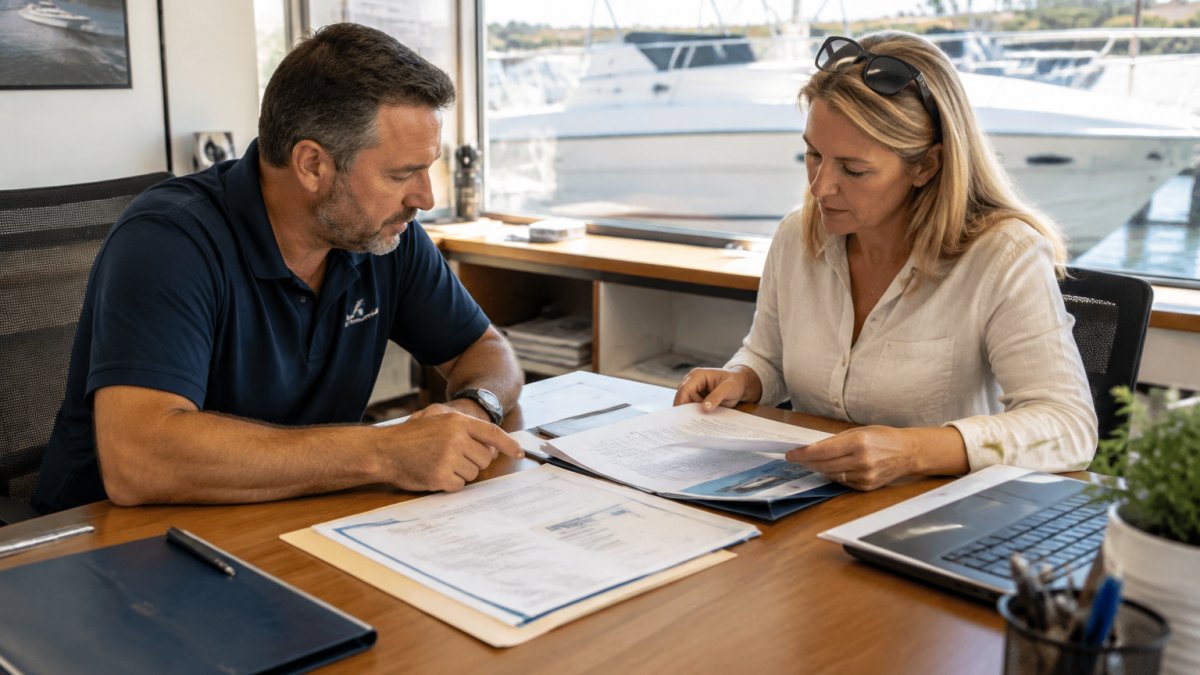
Verifying a carrier’s insurance documents takes about ten minutes and is the highest-value step in the whole process. The checklist below is the minimum; the notes after it explain what each line actually proves, because a certificate that ticks every box can still leave you uncovered.
- Certificate of currency received, dated within the last 12 months
- Insured party name matches the business you are contracting with
- Policy type names goods in transit or marine cargo, not just public liability
- Policy limit stated and compared against your boat’s insured value
- Expiry date falls after your delivery date
- Excess amount confirmed in writing
- Exclusions list requested and read
- Insurer contacted directly to confirm the policy is current
What Each Document Actually Proves
A certificate of currency is a snapshot, not a guarantee.
Public liability and goods-in-transit are different policies doing different jobs. Public liability covers injury to people and damage to third-party property; it does not pay for your boat. Goods-in-transit or marine cargo cover is the policy that responds to damage to the vessel while it is in the carrier’s custody.
The insured party name must match the entity you are contracting with, not a related company, a trading name, or a broker. If the certificate names “XYZ Holdings Pty Ltd” but your quote is from “XYZ Boat Moves”, ask for the connection in writing.
The Gaps Owners Miss
Policy limits are usually stated per load, not per boat. If the carrier is moving two boats on the same float, the limit is shared. Ask how the limit applies to your consignment and get the answer in writing.
Exclusions matter more than the limit. Common goods-in-transit exclusions include inadequate securing by the carrier, damage caused by the boat’s own pre-existing defects, and loss during loading or unloading unless specifically endorsed. Read the exclusions list, not just the schedule.
Watch out: a certificate of currency that is current on the day you book can expire before your delivery date. Check the expiry against the scheduled delivery, not the booking date.
Confirming Directly With the Insurer
Ring the insurer’s claims line, not the broker’s mobile, and quote the policy number. Ask three questions: is the policy current today, does it cover goods in transit for boat carriage, and what is the limit per load. Note the date, time and the name of the person you spoke to. If the carrier resists this step, treat that as a signal about how a claim will be handled.
Our walkthrough of moving a boat from Perth to Brisbane shows what a properly documented move looks like from start to finish.
Boat Transport Insurance Claim Checklist After Damage
A boat transport insurance claim checklist should be started at the moment of delivery, not the next morning. Most policies impose notification deadlines measured in days, and the evidence you fail to capture in the first hour is usually the evidence that decides the claim.
At the Point of Delivery
Photograph the damage before the driver leaves, from wide, mid and close range, with something in frame that establishes scale. Note the damage on the delivery docket in specific terms (“gelcoat crack starboard bow, approximately 300 mm”) rather than “damaged”, and get the driver’s signature against the notation. If the driver refuses to sign, photograph the docket and the refusal, and note the time.
Do not move the boat, wash it, or begin repairs before the assessor has seen it unless the damage creates a safety or pollution risk. Moving or repairing without authorisation is the most common reason a legitimate claim is reduced.
Notification Deadlines
Goods-in-transit and marine cargo policies typically require notification within a short window, often 7 to 14 days, and some require immediate notice where the loss may exceed a stated threshold. Your own comprehensive policy usually requires notice within 30 days, but the transport agreement may impose a shorter contractual deadline on the carrier. Lodge with the carrier in writing the same day, and lodge with your own insurer within their stated window even if you expect the carrier to pay. Late notification is a defence insurers use routinely.
The Evidence Pack
Gather and keep, in one folder:
- The signed delivery docket with the damage notation
- Timestamped photos from every angle, plus your pre-loading photos
- The carrier’s certificate of currency and the transport agreement
- Any third-party repair quote or assessor’s report
- Correspondence with the carrier about the damage
- The damaged components themselves, until the assessor has seen them
Pre-loading photos are the single most valuable item. They establish the boat’s condition before the move and shift the argument from “was it damaged?” to “who caused it?”. If you did not take them, say so early rather than letting the insurer discover the gap.
Carrier First, Then Your Own Insurer
Lodge with the carrier first, because their liability policy is the primary response for damage they caused. If the carrier disputes liability, denies the claim, or their limit falls short of the loss, lodge with your own insurer. Your policy may then pursue the carrier by subrogation, which is why you should not sign a release or settle directly with the carrier without your insurer’s agreement.
Watch out: accepting a cash settlement from the carrier before your insurer has assessed the loss can extinguish your own policy rights. Get the insurer’s position in writing first.
Mitigation and Salvage
You have a duty to mitigate the loss. That means securing loose items, covering broken hatches, and preventing further water ingress, but not commissioning repairs. Keep receipts for any mitigation costs, because most policies reimburse reasonable mitigation expenses even where the underlying claim is later disputed.
If the boat is a constructive total loss, the insurer may take title to the wreck. Do not dispose of the vessel or its components until that is resolved in writing.
Premiums, Excesses and How Insurers Value Your Boat
Premiums, excesses and valuation methods determine what you actually recover, and the gap between market value and agreed value is where owners get stung. Insurers value boats on agreed value, market value or a depreciated basis, and the policy schedule will say which.
Premiums depend on the vessel, route and other factors. Ask your broker for a quote against your actual insured value. Compare the excess to the premium: a low premium with a high excess often costs more than it saves on a single claim. For the contracting side of the move, see our interstate boat transport service overview.
Book Your Interstate Boat Move With Load Up
The paperwork matters, but so does the operator holding the wheel. Load Up runs weekly services to Darwin, Perth, Adelaide, Brisbane and Melbourne, moving boats, caravans and farm machinery.
Load Up can talk you through its services and what they include before you commit. Get in touch to make a booking or arrange a quote.
Insurance requirements for a boat move are rarely the reason a move fails, but they are always the reason a claim succeeds or collapses. Get the certificate of currency, declare the carrier to your insurer, and photograph the hull before it leaves the yard. Load Up provides weekly interstate routes, boat and caravan handling, and heavy machinery transport, so you can book the move and sort the paperwork with one team.
Frequently Asked Questions
Is my boat covered by insurance while it is being transported?
It depends on your policy wording, not on the fact that a carrier is moving it. Many recreational boat policies cover damage in transit by road, but some limit cover to a specified radius from your registered address or exclude transit entirely. Ring your insurer before the move and confirm three things: that road transit is covered, the maximum insured value they will pay, and whether you need to name the carrier. If your policy excludes transit, a standalone marine transit policy covers the gap for the journey.
What insurance should a boat transporter carry?
Ask for a certificate of currency showing public liability cover and, where offered, goods in transit or carrier liability cover. Public liability protects third parties and property the carrier damages, not your boat. Goods in transit cover is what responds when the load itself is damaged. Check the insured value limit against your boat’s market value, confirm the policy is current, and ask whether the excess is passed on to you. A carrier who cannot produce a certificate of currency on request is a risk you do not need to take.
What is the difference between transporter liability and marine transit insurance?
Transporter liability is the carrier’s own cover and responds only up to its policy limit, often a per-tonne or per-load cap that can sit well below your boat’s value. Marine transit insurance is your policy and pays out based on the insured value you declared, regardless of who was at fault. Most disputes happen because an owner assumed the carrier’s cover was enough. Read the limit on the carrier’s certificate, compare it to your boat’s value, and take out transit cover for the shortfall.
Do I need separate transit insurance for an interstate boat move?
Only if your existing policy does not already cover road transit. Check the product disclosure statement for transit exclusions, distance limits and requirements around professional carriers. If transit is included, confirm the insured value is current and that your boat dimensions and weight are declared accurately. If it is excluded, a one-off marine transit policy for the trip is usually cheaper than upgrading your annual cover. Either way, get the confirmation in writing before the boat is loaded.
What information do I need to make a boat transport insurance claim?
Gather the transport agreement, the carrier’s certificate of currency, pre-loading photos and video of the hull, trailer and fittings, and the signed condition report from pickup. After delivery, photograph the damage before moving anything and keep any broken parts. Report the damage to the carrier in writing immediately, then lodge the claim with your insurer within their required timeframe. Include repair quotes from an approved marine repairer. The claim checklist in this guide walks through the sequence in order.
Does boat transport insurance cover damage caused by poor loading?
It can, but exclusions around inadequate securing are common. Insurers expect the boat to be properly strapped, the trailer rated for the load, and the tow vehicle suitable. If the carrier loaded the boat, their liability cover may respond, subject to their limit. If you loaded it yourself and it shifted, your own transit policy may decline the claim on the grounds of inadequate securing. Document the loading with photos and confirm in writing who is responsible for strapping down.

