
Quick Summary
Interstate boat transport safety depends on planning before the truck leaves: inspect the hull, trailer and load in staged passes, secure loose items, check permits for every jurisdiction on the route, and clean the hull to meet biosecurity rules before crossing borders.
- Complete structural, mechanical and load-security checks in the days before pickup, then repeat them at collection.
- Balance the load so tongue weight sits within the coupling and tow vehicle rating.
- Clean and dry the hull, running gear and bilges before crossing state borders.
- Confirm oversize permit requirements for every jurisdiction on the route, not just the origin.
- Retighten adjustable straps after the first 50 to 100 kilometres of travel.
Table of Contents
- Why Interstate Boat Transport Needs More Planning Than a Local Tow
- Preparing a Boat for Road Transport: The Pre-Transport Checklist
- Oversize Boat Transport Regulations and Road Permits
- Boat Transport Insurance Requirements and Documentation
- Booking Your Interstate Boat Transport With Load Up
- Frequently Asked Questions
Why Interstate Boat Transport Needs More Planning Than a Local Tow
Last Updated: November 12, 2026
Moving a boat across state lines is a different job from a local tow. A route that looks simple on a map can become complicated once you factor in road rules, weight limits, permits and biosecurity checks. Interstate boat transport safety depends on getting those details right before the truck leaves the yard.
Interstate travel means your boat may pass through several jurisdictions, each with its own height, width and length rules for trailered loads. A rig that is legal in one state can need a permit to cross the border into the next.
Distance also raises the stakes. Vibration, temperature swings and hours on the highway all work against a poorly prepared boat. A loose cover, an unsecured tank or a worn bearing that would be a minor fix at home can become a roadside emergency hundreds of kilometres from help.
Preparing a Boat for Road Transport: The Pre-Transport Checklist
A pre-transport inspection is not a quick walk-around. Treat it as a staged check you complete in the days before pickup, then repeat at the ramp or hardstand on the morning of collection. For a parallel preparation process, see the caravan transport checklist with costs and timing.
Structural pass. Check the hull for cracks, stress crazing around cleats and fittings, and soft spots in the transom and floor. Look at the keel and chines for damage that could catch on a bunk or strap.
Mechanical pass. On the trailer, check tyre tread and sidewalls for cracking, bearing condition (spin each wheel and listen for rumble or roughness), brake operation if fitted, and that all lights, indicators, brake, tail and clearance, work.
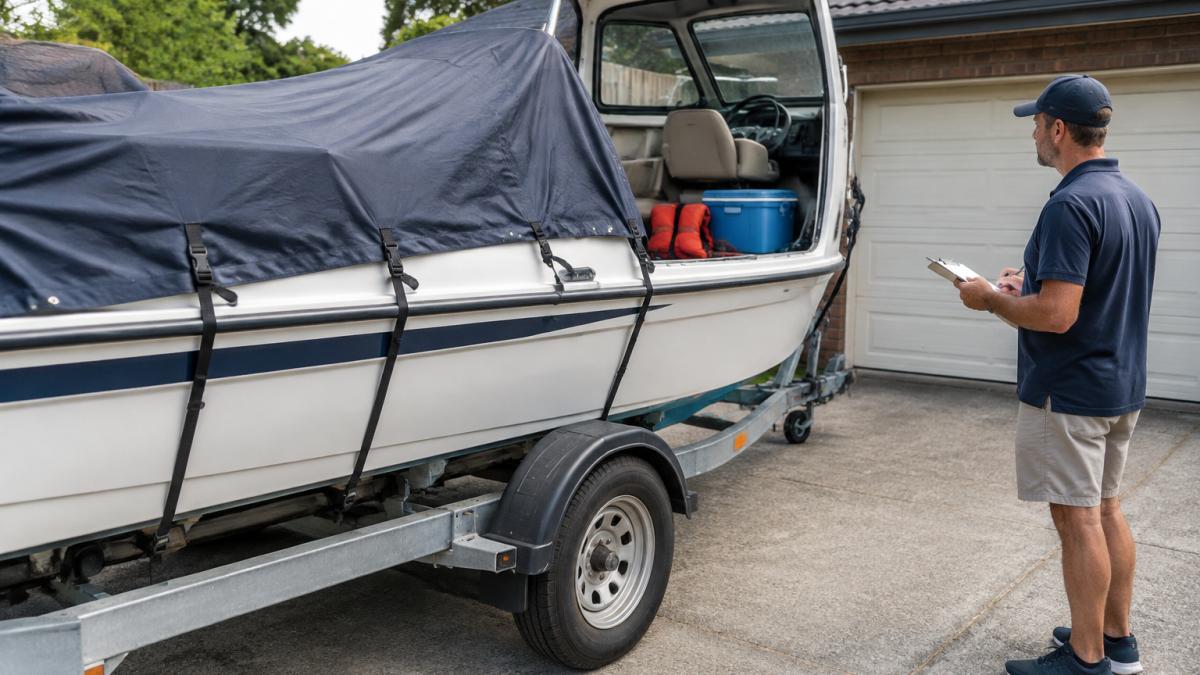
Load-security pass. Confirm every tie-down point is sound and that straps are rated for the load.
Securing Loose Items, Fuel and Equipment
Remove rods, electronics, tackle and anything not bolted down. Stow what stays on board in sealed containers secured so they cannot shift. Tape down or remove navigation lights and antennas that could be knocked loose by wind or vibration.
Fuel needs particular care. Drain or reduce tanks to the level your transporter specifies, and keep spare fuel out of the boat entirely. Carry emergency flares, a fire extinguisher and a basic toolkit in the tow vehicle rather than inside the hull, so you can reach them without unloading.
Hull, Trailer and Load Distribution Checks
Balance matters as much as strength, and this is where most generic guides stop short.
Keep the centre of gravity low and centred over the trailer axle group. Heavy items such as batteries, anchors and fuel should sit low and slightly forward of the axle, not high in the cabin or at the transom.
Watch out: a rig that tows straight at 80 km/h can begin to sway at 100 km/h if the weight distribution is marginal, so test the setup at highway speed before committing to a long leg.
Biosecurity and Hull-Cleaning Checks Before Crossing Borders
This is the step most guides omit, and it is the one most likely to stop your load at a border. Marine pests and invasive species are managed under state and territory biosecurity arrangements, and a boat moving between jurisdictions can be inspected and, if fouled, required to be cleaned before it proceeds.
Before transit, inspect the hull, running gear, anchor well, live wells, bilges and any wet gear for fouling, weed or sediment. Clean and dry the boat and trailer, drain all water, and remove any plant or animal material. Keep a record and photos of the clean condition.
The three inspection passes below summarise what to check before the boat leaves.
| Pass | What to check | When |
|---|---|---|
| Structural | Cracks, stress crazing, soft spots, bunk contact | Days before pickup, then at collection |
| Mechanical | Tyres, wheel bearings, brakes, lights, coupling | Days before pickup, then at collection |
| Load-security | Tie-down points, rated straps, bimini and antennas removed | Days before pickup, then at collection |
| Biosecurity | Hull, running gear, live wells, bilges, wet gear | Before crossing borders |
| Straps after transit | Retighten adjustable straps | After the first 50 to 100 km |
Oversize Boat Transport Regulations and Road Permits
Some boat and trailer combinations exceed standard width, height or length limits, and the requirements are set by the relevant road authorities for each jurisdiction.
Oversize loads may require a permit and additional conditions set by the relevant road authority (Oversize Overmass). Check the requirements for your route before you travel. Requirements can vary between jurisdictions, so check the current rules with each relevant road authority before you book.
Build permit windows into your schedule from the start. A missed permit window can delay a whole haul, and escorts and pilot vehicles often need to be booked separately.
Watch out: assuming one permit covers the whole route is one of the most common and costly mistakes; each jurisdiction’s requirements can differ, and a permit valid at origin does not guarantee passage at the border.
Documentation to Carry With the Load
Keep the paperwork together and accessible in the tow vehicle: the boat’s registration, ownership documents, the trailer’s registration, a copy of the insurance certificate, the booking confirmation and copies of every permit and escort arrangement. If the boat is damaged or inspected, these documents and a dated photo record of its condition at pickup are what support a claim or resolve a dispute at the roadside.
Boat Transport Insurance Requirements and Documentation
Before a boat moves, confirm what your existing policy covers. Many marine policies cover the boat while it is on the water or at rest, but not always while in transit on a trailer.
Keep your paperwork together: the registration, the boat’s ownership documents, the trailer’s registration, a copy of your insurance certificate and the booking confirmation. If the boat is damaged, these documents and a dated photo record of the condition at pickup are what support a claim.
Ask any transporter for proof of their goods-in-transit cover, and read the excess and exclusions. To compare providers before you book, read how to choose an interstate heavy equipment mover. A low headline price can hide a large excess that you end up paying.
Booking Your Interstate Boat Transport With Load Up
Load Up moves boats, caravans, farm machinery and other heavy equipment with weekly service routes connecting Darwin, Perth, Adelaide, Brisbane and Melbourne. Get your pre-transport checklist done first, then send your boat’s dimensions, weight and route so the booking matches your load. Pricing depends on quantity, dates and delivery, so get in touch for a quote tailored to your move.
Common questions and mistakes
- Skipping the post-transport check. Inspect the boat, cover and straps on arrival and photograph anything unusual before you sign off.
- Assuming one permit covers the whole route. Requirements can differ between jurisdictions.
Frequently asked questions
Do I need insurance to transport a boat interstate?
Your transporter should carry goods-in-transit cover, and your own policy should be checked for road transport. Confirm both before the boat is collected.
Who handles oversize permits?
This depends on the job and the agreement with your transporter. Ask Load Up to confirm exactly what is arranged for your load.
Get in touch to make a booking or arrange a quote.
Frequently Asked Questions
What are the legal requirements for towing a boat across state borders?
Towing a boat interstate requires a towing vehicle rated for the combined weight, a trailer registered in its home state and a current roadworthy certificate where applicable. Check the current rules with the relevant road authorities before you travel, because requirements for registration, dimensions and load restraint can differ between jurisdictions.
What insurance should I have for interstate boat shipping?
Confirm that your boat insurance covers transit, not only storage or use on the water, and ask whether it extends to the trailer and any attached equipment. If a professional carrier moves the boat, check their public liability and goods in transit cover, and ask what the policy excludes. Keep copies of your policy, the carrier’s certificate of currency and photos of the boat taken before loading, so any damage claim can be assessed quickly.
How do I secure loose items on a boat before transport?
Remove or stow anything that could shift, including fishing rods, electronics, cushions and loose fuel cans, and secure what must stay aboard with ratchet straps rated for the load. Drain or lock fuel lines and remove the outboard fuel tank where possible. Tie down the boat cover so it cannot flap at highway speeds, and check all straps again after the first 50 kilometres of travel.
Are there specific width and height restrictions for boat transport on roads?
Yes. Trailers and loads have maximum width, height and length limits, and wider or taller loads may need a permit. Measure the boat on its trailer from the highest point, including antennas and bimini frames, before booking. If the load exceeds standard limits, ask your carrier whether an oversize permit is needed and how long approval typically takes.

