
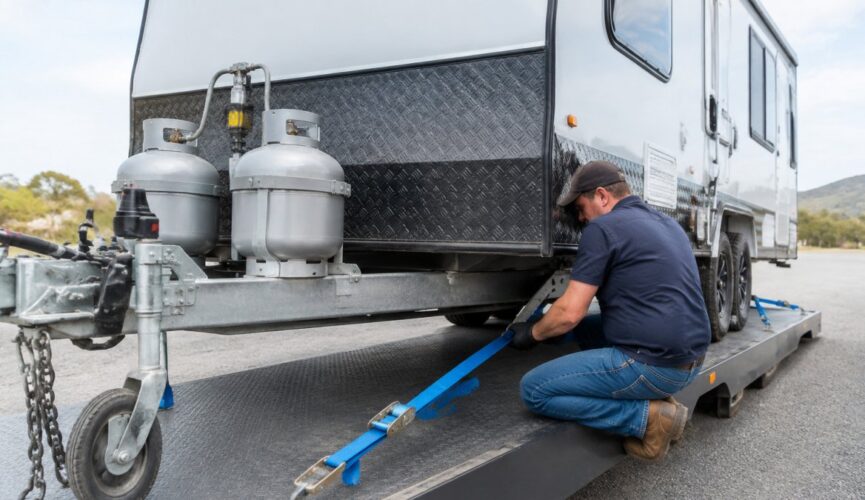
Last Updated: November 7, 2026
Quick Summary
Safely securing a caravan means using the chassis’s designated tie-down points with rated ratchet straps angled at roughly 30 to 45 degrees, so the straps oppose movement in every direction. Tension the straps evenly in a cross pattern, add a secondary restraint or wheel chocks, then re-check tension after the first few kilometres and at each stop.
- Check tyres, brakes, lights and coupling the day before, then re-check cupboards, fridge, doors and hatches on the morning of transport.
- Never use the axle, body panels or suspension as tie-down points, and consult the manufacturer’s guide if no points are marked.
- After the first 10 to 20 kilometres, stop and check strap tension, coupling security, wheel nuts and tyre pressures.
- Turn gas bottles off at the valve, keep them upright and secure them so they cannot move or fall.
- Load the van and weigh it at a public weighbridge so ATM, GTM and tow-ball download all line up.
Table of Contents
- Your Complete Caravan Transport Checklist
- Securing Caravan Contents for Transport
- How to Tie Down a Caravan on a Trailer
- Caravan Gas Bottle Transport: What You Need to Know
- Weight Limits, Towing Capacity and Compliance Checks
- Book Your Caravan Transport with Load Up
- Frequently Asked Questions
Your Complete Caravan Transport Checklist
Safely securing a caravan for transport starts before you touch a single strap. Load Up moves caravans on weekly runs between Darwin, Perth, Adelaide, Brisbane and Melbourne. Caravans that arrive in good condition are usually the ones prepped properly beforehand. This guide sets out a sensible sequence to follow.
The core idea is simple: a caravan is a box full of heavy things balanced on a single axle. Everything you do is about stopping those things from moving.
Below is the full checklist, then the detail behind each step.
| Stage | What You Check | Why It Matters |
|---|---|---|
| Day before | Tyres, brakes, lights, coupling | Catches faults while you can still fix them |
| Morning of | Cupboards, fridge, doors, hatches | Stops loose items becoming projectiles |
| Loading | Tie-down points, strap angles | Keeps the van fixed to the trailer |
| Final check | Weight, chains, breakaway, locks | Meets compliance and theft protection |
| En route | Straps, wheels, load | Catches problems before they grow |
Before You Leave: Pre-Transport Checks
Start with the van itself. Walk around it and check the tyres for cracks, bulges and correct pressure. Test the brakes and confirm every light works.
Then check the tow vehicle. Tyre pressure, tow-ball condition, and the rating plate all matter. Your tow vehicle’s towing capacity must cover the caravan’s ATM, and your tow-ball download must sit within the vehicle’s limit.
For a deeper walkthrough, our guide on how to prepare a caravan for transport in 7 steps covers the full prep sequence in more detail.
The Day of Transport
On the morning itself, do a second walk-through. Things loosen overnight. Check that the jockey wheel is raised and locked, the handbrake is off, and the breakaway system is connected and tested.
Watch out: leaving the handbrake on during loading is a common mistake. It can drag the brakes and damage the drums before you’ve left the driveway.
Confirm the safety chains cross under the coupling and have enough slack to turn but not enough to hit the ground.
Securing Caravan Contents for Transport
Securing caravan contents for transport is the step most owners rush, and it’s where damage usually starts. Empty the van of anything you don’t need to move. For what stays, work through it methodically:
- Cupboards and drawers: latch every door, then check they hold under a firm pull. Fit child locks or travel catches where latches feel weak.
- Fridge door: lock it or strap it shut. A fridge door swinging open mid-transit wrecks hinges and scatters shelves.
- Loose items: pack crockery, kettles and anything glass into boxes on the floor, not on benches.
- Exterior equipment: stow hoses, mats and annexe poles inside or in a locked boot.
- Gas bottles: turn the bottle off at the valve before you move.
Anything heavy belongs low and over the axle. Never store dense items in the rear of the van, because that lightens the tow-ball and causes sway.
How to Tie Down a Caravan on a Trailer
How to tie down a caravan properly comes down to four anchor points, rated straps and correct strap angles. Use the caravan’s designated chassis tie-down points, never the axle, the body panels or the suspension. If the van has no marked points, consult the manufacturer’s guide before you improvise.
Here’s the sequence:
- Position the van so its weight sits centred over the trailer axles, with the tow-ball download still within the tow vehicle’s limit.
- Attach ratchet straps to the four corners of the chassis, using the manufacturer’s designated points.
- Angle each strap forward or backward at roughly 30 to 45 degrees so the straps oppose movement in every direction.
- Tension each strap evenly, working in a cross pattern, until the webbing is firm but not crushed.
- Fit a secondary restraint or chock the wheels as a backup.
- Re-check tension after the first few kilometres and again at each stop.
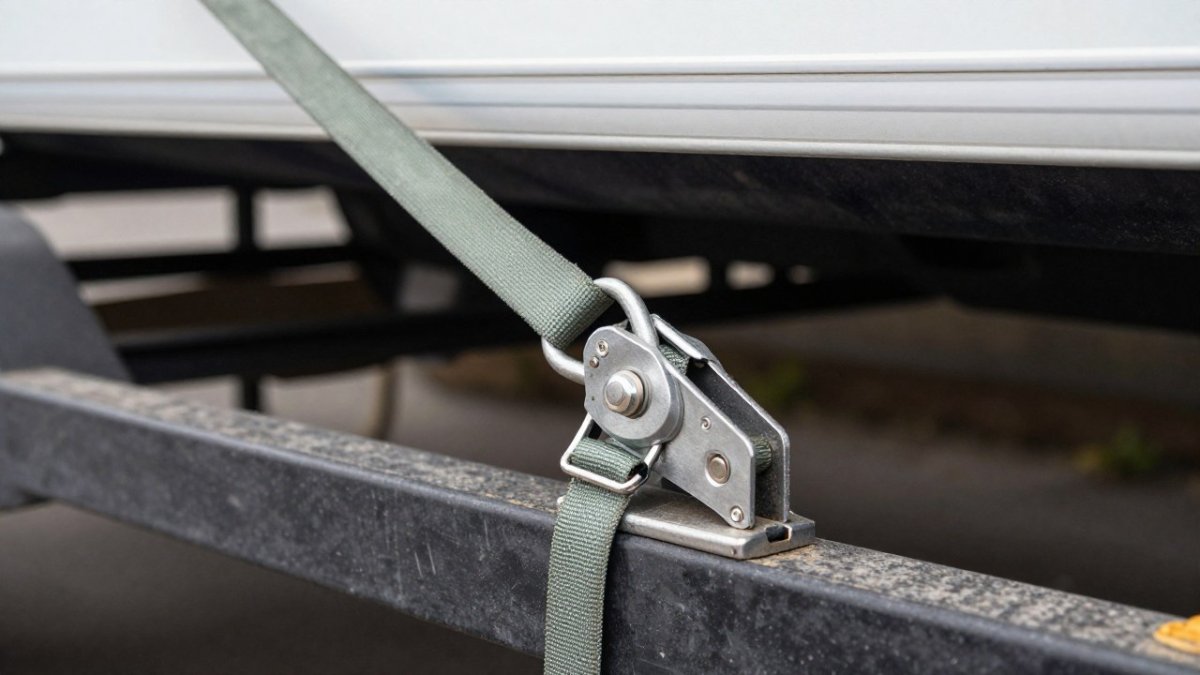
Tie-Down Points and Restraint Geometry
Restraint geometry is the angle and direction of each strap relative to the load. A strap pulling straight sideways does little to stop forward movement.
Use rated ratchet straps, not rope. Check the strap’s working load limit against the van’s weight, and remember that a strap’s rating applies to the strap, not to the anchor point or the trailer deck.
Watch out: a strap that is over-tensioned can crush body panels or distort a chassis point, while an under-tensioned strap will loosen once the van settles on the trailer.
Loading a Caravan onto a Flatbed or Transport Trailer
Not every caravan move involves towing. If the van is being carried on a flatbed or specialised transport trailer, the loading procedure matters as much as the straps.
Once loaded, confirm the van sits centred and the trailer’s own weight distribution is not upset. Secure the ramps, close and lock the van, and fit wheel chocks or a secondary restraint before tensioning the main straps.
Post-Loading and En-Route Rechecks
A timed recheck routine catches problems before they grow. After the first 10 to 20 kilometres, stop and check strap tension, coupling security, wheel nuts, tyre pressures and any sign of load movement. Repeat at each fuel stop or roughly every two hours. Look for shiny wear marks on straps, shifted chocks and loosened turnbuckles. If a strap has slackened, retension it and investigate why rather than simply tightening it again.
Caravan Gas Bottle Transport: What You Need to Know
Caravan gas bottle transport rules are strict, and for good reason. Turn the bottle off at the valve, keep it upright, and secure it so it cannot move or fall.
Check the bottle’s test date before travel. If it’s overdue, get it retested or replaced. For the current requirements, check the Australian Dangerous Goods Code guidance or your state’s dangerous goods regulator, since rules vary by jurisdiction.
Remove the bottle entirely if your route or carrier requires it. Ask before you load.
Weight Limits, Towing Capacity and Compliance Checks
Weight compliance is where a lot of caravan moves quietly go wrong. You need three numbers to line up:
- ATM (Aggregate Trailer Mass): the caravan’s maximum loaded weight.
- GTM (Gross Trailer Mass): the weight carried by the van’s axle alone.
- Tow-ball download: the downward force at the coupling, which must stay within the tow vehicle’s limit.
Load the van, then weigh it. A public weighbridge can give you accurate figures.
Also confirm your safety chains, breakaway system, lights and coupling all meet Vehicle Standards Bulletin guidance for your setup. Keep your registration and any permits in the vehicle.
Book Your Caravan Transport with Load Up
If the prep list feels long, that’s because it is. Doing it right protects your van, but many owners would rather hand the whole job to a professional transport service.
Load Up runs weekly service routes linking Darwin, Perth, Adelaide, Brisbane and Melbourne, and handles caravans, boats and farm machinery.
Ready to move? Arrange your interstate caravan transport and we’ll get your van on the next run. You can also get a quote and book your pickup once you know your dates.
Moving a caravan interstate shouldn’t mean crossing your fingers and hoping it arrives intact.
Frequently Asked Questions
How do you secure a caravan for transport?
Securing a caravan for transport means locking down three things: the van itself, everything inside it, and the connection to the tow vehicle or trailer. Latch every cupboard and the fridge door, close and lock all windows, hatches and vents, and remove loose items. Secure the coupling with a lock, cross the safety chains, and check the breakaway system. On a flatbed, use rated ratchet straps on the chassis tie-down points, not the body or awning. Walk around the van after the first 50km and re-tension anything that has shifted.
What should you remove or secure inside a caravan before transport?
Take out anything heavy or loose: crockery, tools, TVs, portable appliances and free-standing furniture. Empty the fridge and leave the door latched open or secured shut. Secure cupboard doors with latches or tape, and pack soft items around fragile contents. Lock the ensuite door and any sliding partitions. The goal is nothing that can become a projectile under braking. If you are using a professional carrier, ask whether they require the van empty; many do, and it also protects your belongings from transit damage.
Can you transport a caravan with gas bottles attached?
You can transport a caravan with gas bottles fitted, but the bottles must be turned off at the valve, secured upright in their brackets, and have the valve protection caps fitted. Check that the bottle restraint is tight and the hose is not kinked. Some carriers ask for bottles to be removed and transported separately, so confirm before the pickup. Never transport a bottle lying loose inside the van or in a closed locker without ventilation. If in doubt, remove the bottles and store them upright in a ventilated space.
How do you stop a caravan from moving on a trailer?
The van is held by the coupling, the safety chains and the tie-down straps working together. Set the handbrake off, chock the wheels during loading, then tension four ratchet straps from the chassis rails to the trailer deck at opposing angles. Use rated straps and check the working load limit against the van’s weight. Re-check tension after the first 50km, because straps settle. A wheel chock or cradle at the base of the tyres adds a physical stop if a strap loosens. Never rely on the coupling alone.

