
Last Updated: November 3, 2026
Quick Summary
Oversized farm machinery permits are required when a load exceeds standard width, height, length, or mass limits on public roads. First check whether a national notice or exemption already covers your vehicle, then measure the full loaded combination and apply through the authority that manages each route.
- Check first whether a national notice or exemption already covers the load.
- Measure width, height, length, gross mass and axle group mass with the load on board.
- Plan the full route and identify every state or territory border crossed.
- Read every permit condition on route, travel times, speed and escorts before travelling.
- Carry the permit in the vehicle and amend it if the route or load changes.
Table of Contents
- Permit eligibility and applicable vehicle classes
- Checking Agricultural Vehicle Dimensions and Mass Limits
- Step-by-Step: Applying for Your Agricultural Vehicle Permit
- Planning Your Oversized Machinery Route
- Pilot and Escort Requirements for Agricultural Vehicles
- Booking Your Transport: What to Send Load Up for a Quote
- Frequently Asked Questions
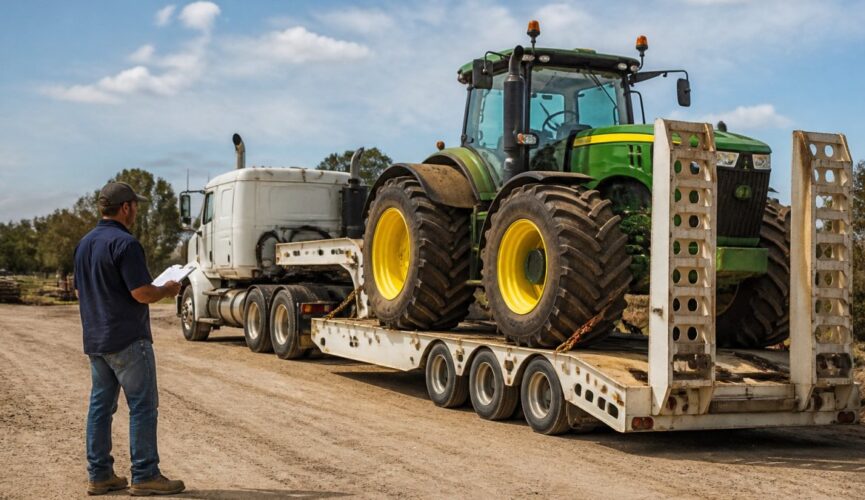
If you are moving a harvester, tractor, or large implement on public roads, you may need farm machinery permits. Permit questions are among the first things customers raise when moving farm machinery. Getting it right before the load moves saves time, money, and trouble at the roadside.
Permit eligibility depends on the vehicle, its dimensions and mass, and the route. Many agricultural loads exceed standard limits, which means the transport operator must check the rules that apply in each state or territory the load will travel through.
Permit eligibility and applicable vehicle classes
Not every farm vehicle needs a permit. The rules depend on whether the combination is an agricultural vehicle or a general heavy vehicle, and on how far it exceeds standard dimension or mass limits.
Check these points first:
- Is the vehicle a registered agricultural vehicle under the relevant state rules?
- Does the combination exceed the standard width, height, length, or mass limits?
- Does the load travel on public roads, not only on the owner’s property?
- Will the trip cross a state or territory border?
The National Heavy Vehicle Regulator publishes the national framework for heavy vehicle permits and the vehicle classes they apply to (National Heavy Vehicle Regulator permit information). Read the current requirements before you assume your load is exempt.
National notices, exemptions and state-specific rules
Some loads fall under national notices or exemptions, while others still need an individual permit. State and territory road authorities add their own conditions on top of the national rules, so a load that qualifies in one state may need extra approval in another.
Watch for these differences:
- Different maximum width or length allowances between jurisdictions
- Specific travel restrictions on certain roads or times of day
- Separate approval needed for crossing a border
Checking Agricultural Vehicle Dimensions and Mass Limits
Start with measurements, not guesses. Measure the full combination as it will travel, including the implement, the tow vehicle, and any load overhang.
Record these figures:
- Overall width, including mirrors and attachments
- Overall height, including any raised header or loader arm
- Overall length of the combination
- Total gross mass, and the mass on each axle group
Compare each figure with the standard limits and the excess dimension thresholds set by the regulator. If any measurement is over the limit, a permit is likely required. Keep a copy of your measurements, because the permit application asks for them.
Step-by-Step: Applying for Your Agricultural Vehicle Permit
The steps below outline a general sequence for permit applications. Exact screens and labels differ between jurisdictions, so check the requirements of each authority involved.
Step 1, Confirm the vehicle class and whether a national notice applies.
Before you open an application, establish whether the combination is an agricultural vehicle, a special purpose vehicle, or a general heavy vehicle.
Step 2, Measure the combination as it will travel.
Record overall width (including mirrors and any attachment), overall height (including a raised header or loader arm), overall length, total gross mass, and the mass on each axle group. Measure the combination loaded, not empty.
Step 3, Plan the full route, including every jurisdiction.
Map the route from origin to destination, noting every state or territory border, every council road, and any bridge, level crossing, or overhead structure that could constrain the load.
Step 4, Lodge the application through the correct portal.
Applications are lodged with the authority that manages the route, which may be the National Heavy Vehicle Regulator or a state or territory road authority. Attach the supporting documents the relevant authority requests.
Step 5, Respond to route assessment and requests for information.
Complex loads, particularly those over height, over mass, or travelling on council roads, may be referred for route assessment or engineering review. Respond promptly to any request for clarification.
Step 6, Read the permit conditions before you travel.
When the permit is issued, read every condition: approved route, travel times, speed limits, escort requirements, and any road or bridge restrictions. Conditions are not boilerplate, they are specific to your load and route, and travelling outside them can invalidate the permit.
Get in touch to make a booking or arrange a quote. →
Step 7, Carry the permit and comply throughout the journey.
Keep a copy of the permit in the vehicle, ensure the driver and any escorts understand the conditions, and follow them for the entire trip. If the route or load changes, check whether an amended permit is required before moving.
Watch out: applying with incomplete axle mass figures or a route that covers only part of a multi-state trip can lead to a returned application and a delay to your transport date.
National Heavy Vehicle Regulator permit information
The permit application follows a sequence of steps, each with its own timing and action.
| Step | What to do | Timing or detail |
|---|---|---|
| 1. Confirm vehicle class | Check whether a national notice or exemption applies | Before opening an application |
| 2. Measure the combination | Record width, height, length, gross mass and axle group mass | Measure loaded, not empty |
| 3. Plan the full route | Note every border, council road and constraint | Identify each authority involved |
| 4. Lodge the application | Submit via the correct portal with supporting documents | Lodge with the route-managing authority |
| 5. Respond to assessment | Answer queries from the assessing authority | Respond within the requested window |
| 6. Read permit conditions | Check route, travel times, speed and escort rules | Before you travel |
| 7. Carry and comply | Keep permit in vehicle and follow conditions throughout | Amend permit if route or load changes |
Planning Your Oversized Machinery Route
A permit approves the vehicle, but it does not guarantee that every road on your route can take the load. Check route access and road suitability before you commit.
Route access, road suitability and interstate handoffs
Look at bridges, tight turns, overhead clearances, and road width along the entire route. Many council roads are not built for oversized loads, even if the main highway is.
When the load crosses a border, the permit conditions change at each jurisdiction. To see how loads are followed across states once they are on the road, read how loads are tracked across state lines. Confirm which authority covers each leg and make sure the conditions in each state are compatible. Planning this handoff early prevents a stop at the border with a load that cannot legally continue.
Our tracking article, How Do You Track Interstate Heavy Haulage Loads?, explains how loads are followed across states, which helps when you plan a multi-leg route.
Pilot and Escort Requirements for Agricultural Vehicles
Some oversized loads need a pilot or escort vehicle. The conditions in your farm machinery permits set whether one is required, how many vehicles are needed, and what equipment they must carry.
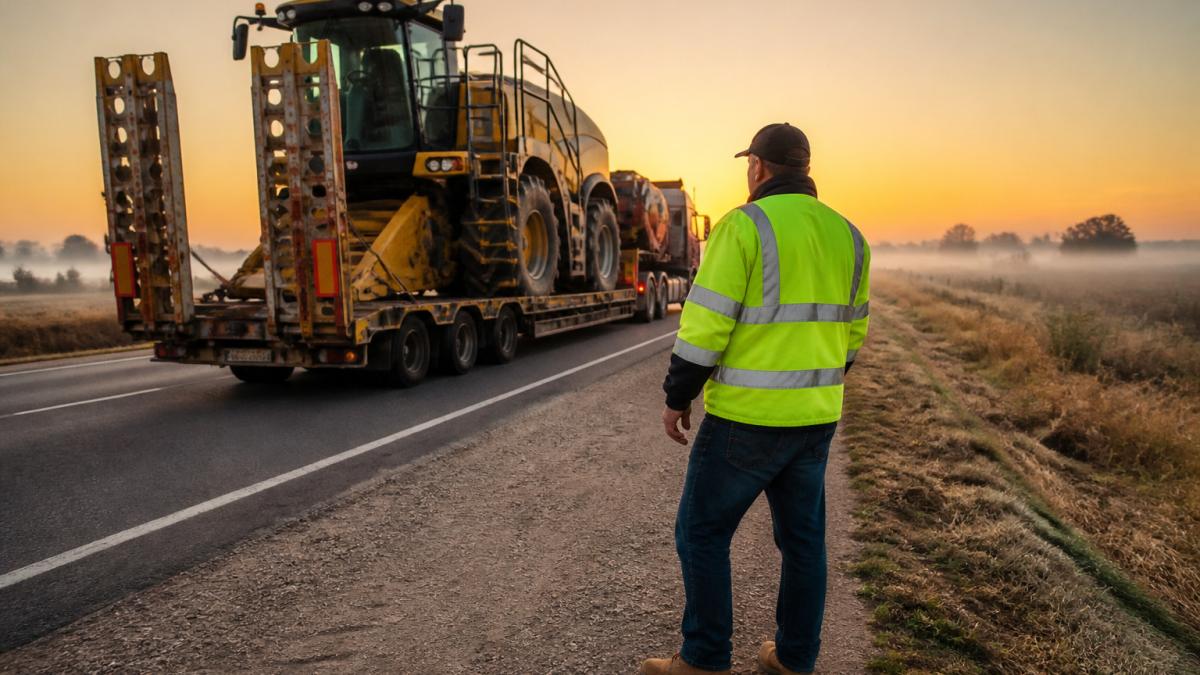
Pilot drivers usually need to:
- Stay in clear communication with the driver of the load
- Carry the required warning signs and lighting
- Warn other road users ahead of the load
!A pilot vehicle driver in a high-visibility vest beside a flatbed truck carrying a large harvester on a rural road at dawn
Check the exact pilot requirements in your permit conditions, because they vary with load size and route.
Booking Your Transport: What to Send Load Up for a Quote
If you would rather hand the permit and transport planning to a professional, send us the details below and we will prepare a quote:
- The machinery type and its make and model
- Overall width, height, length, and total mass
- Pickup and delivery locations
- Your preferred transport dates
Pricing depends on quantity, dates, and delivery, so a quote is provided once the full job is known. For the service that suits your machinery, see our Interstate Farm Machinery Transport page, or Interstate Tractor Transport if your load is a tractor. Browse our Load Up Interstate Transport range to start a booking, and get in touch to make a booking or arrange a quote.
Frequently Asked Questions
When does farm machinery need an oversize transport permit?
Farm machinery needs an oversize permit when the vehicle or combination exceeds the mass or dimension limits set for standard road travel. Limits differ between a vehicle’s configuration and its load, so measure the complete combination, including the implement or header, before deciding. Check the national agricultural vehicle notice first, since some configurations travel under it without an individual permit. If you are unsure, confirm with the relevant state or territory transport authority before the trip.
How long does it take to get an agricultural vehicle permit?
Processing times vary by state and territory and by how complete your application is. Applications with accurate vehicle measurements, a clear route and the required escort details tend to move faster than those that need follow-up questions. Allow extra time during peak harvest periods, and apply well ahead of your planned move date. Fees also vary by jurisdiction, so check the current schedule with the authority you are applying to.
What details do I need for an agricultural vehicle permit application?
Most applications ask for the vehicle registration details, the overall length, width, height and mass of the combination, the origin and destination, the proposed route and the travel dates. You will also need to state whether a pilot or escort vehicle will be used and what communication equipment it carries. Have measurements taken from the loaded combination rather than the bare machine, so the figures match what will actually be on the road.
Can Load Up handle the permit paperwork for oversized farm machinery?
Load Up can discuss your machinery, route and dates when you request a quote, so you know what is involved before you book. Permit requirements depend on the equipment and the states it travels through, so confirm the specific approvals needed for your load. For current pricing or a quote, get in touch with Load Up directly, as costs depend on quantity, dates and delivery.

